
A Plain-Language Guide to How TelioEV’s Software Connects Everything
Every time you plug in an electric vehicle, a quiet conversation happens behind the scenes. The charger has to talk to the car, the car has to talk to the charger, the charging company has to talk to its own network, and somewhere a payment has to go through. All of that only works because everyone involved agrees on a common set of rules — shared “languages” that let different machines and companies understand each other. These shared rules are called protocols.
TelioEV’s EV Charging Station Software is built on a set of well-known, industry-wide protocols rather than a private, closed-off system. That choice matters a lot in practice: it means the software can work with chargers from many different manufacturers, let drivers use other companies’ charging networks, respond intelligently to the power grid, and keep billing and payment data accurate and secure. This guide walks through each protocol one at a time, explains what it actually does, and shows why it matters — without requiring any technical background.
Why Charging Protocols Matter
Imagine if every charging station spoke its own private language. A charger from one manufacturer wouldn’t be able to report its status to software from a different company. A driver’s app wouldn’t be able to start a session on a charger it didn’t already know about. Every time an operator wanted to add a new charger brand or connect to a new partner network, someone would have to build a custom translator from scratch.
A protocol solves this by acting as a shared rulebook. It defines exactly what information gets sent, in what format, and when. Because the rulebook is public and used industry-wide, any company that follows it can plug into the same ecosystem — similar to how any phone can call any other phone because they all follow the same telecommunication standards, or how any website works in any browser because they all follow the same web standards.
For an EV charging network, open protocols bring three concrete benefits: chargers from different manufacturers can be mixed and matched, new hardware and partners can be added with far less custom engineering, and drivers get a smoother experience — finding a station, starting a session, and paying — no matter which network actually owns the charger.
OCPP — Connecting Chargers to the Central Platform
OCPP stands for Open Charge Point Protocol. It is the communication link between a physical charging station and the central software platform that manages the whole network. Through this link, the platform can send commands to the charger (such as “start charging” or “stop charging”) and the charger can send information back (such as how much energy was delivered, whether it’s free or busy, or whether something has gone wrong).
Think of it like this: OCPP is like the walkie-talkie channel between a store’s checkout counter and its head office. The head office can say “open this register” or “close it for maintenance,” and the register reports back sales and problems in real time.
What OCPP Makes Possible Day to Day
Because of OCPP, an operator can watch the health of every charger in their network from one screen. The protocol reports whether each connector is free, in use, or out of service, which lets support teams catch problems before a driver even notices. It also allows remote software updates and configuration changes, so a technician doesn’t need to physically visit every single site just to adjust a setting.
OCPP also carries the detailed charging session data — how much energy was used and for how long — back to the management platform. That data becomes the foundation for usage reports, accurate billing, and longer-term planning about where to add new chargers.
For TelioEV, supporting OCPP means operators are not locked into one hardware brand. They can choose chargers based on price, features, or reliability, and know the management software will still be able to monitor and control them.
 OCPI — Connecting Different Charging Networks
OCPI stands for Open Charge Point Interface. While OCPP connects a charger to its own company’s platform, OCPI does something different: it connects one company’s charging network to another company’s network, or to a mobility service provider (the company behind the app a driver actually uses).
Think of it like this: OCPI works like the agreements between mobile phone carriers that let you make calls while traveling abroad, even though you’re not a customer of the local carrier. Your phone still works because the carriers agreed on a shared way to recognize and bill each other’s customers.
How OCPI Improves Roaming for Drivers
With OCPI in place, a driver can open a single app, find a charger that belongs to an entirely different operator, and start a charging session there without signing up for a separate account. The protocol shares the details needed to make this possible: the charger’s location, whether it’s available, what it costs, and how the session went once it’s finished.
This also benefits operators. By joining a roaming network, a charging company can effectively offer its customers access to thousands of chargers it doesn’t own, while also earning revenue when visiting drivers use its own stations. OCPI additionally handles the back-end “charge detail records” that let two companies settle payments between each other accurately.
ISO 15118 — The Conversation Between Car and Charger
ISO 15118 is the standard that governs direct communication between an electric vehicle and the charger it’s plugged into. Rather than the charger simply supplying power blindly, the vehicle and charger exchange information: the vehicle’s identity, how much power it can safely accept, and how the charging session should be authorized and billed.
Plug and Charge
The best-known feature enabled by ISO 15118 is called Plug and Charge. Normally, starting a charging session means tapping a card, scanning a QR code, or opening an app. With Plug and Charge, the driver simply plugs in the cable. The vehicle presents a digital certificate — essentially a secure digital ID — and the charging session begins automatically, with billing handled behind the scenes.
Think of it like this: Plug and Charge is similar to how a laptop and a trusted Bluetooth device pair automatically once they’ve been introduced once — no re-typing a password every time, because they recognize each other securely.
Bidirectional Charging
Newer versions of ISO 15118 support power flowing in both directions — not just from the charger into the car, but from the car back out to a building or the electricity grid. This is sometimes called vehicle-to-grid, or V2G. In practice, this means a parked electric vehicle’s battery could supply power during a period of high demand and then recharge later when demand — and electricity prices — are lower.
Turning parked vehicles into a flexible energy resource is still an emerging capability, and it depends on more than just software: the vehicle, the charger, and local electricity regulations all need to support it. Even so, ISO 15118 lays the technical groundwork for this to become mainstream over time.
IEC 61851 — The Safety Rulebook
IEC 61851 is a standard that governs the physical, electrical side of charging — essentially the safety rules that keep the connection between vehicle and charger from causing harm. It defines the electrical signals that control how and when power actually flows, and it sets out the different charging modes a station can support.
TelioEV’s software operates at the digital management layer — monitoring, controlling, and billing — rather than the low-level electrical signaling itself. Even so, this hardware-level safety standard is what makes the physical connection trustworthy in the first place, and it underpins everything the higher-level software does.
OpenADR — Keeping Charging in Sync With the Power Grid
OpenADR lets energy providers send “demand response” signals to connected systems, including EV charging networks. In simple terms, the power grid can tell the charging network when electricity demand across the region is unusually high or unusually low, and the charging network can respond automatically.
Think of it like this: It works a bit like a thermostat that gets a signal to ease off during a regional heatwave to avoid straining the power supply — except here, it’s charging stations easing off during peak electricity demand.
For example, a network might automatically reduce charging speed across its stations during a peak demand period in the afternoon, then allow full-speed charging again once demand drops in the evening. This helps protect grid stability, and because electricity is often cheaper during low-demand periods, it can also reduce costs for fleet operators and site owners who charge strategically.
MQTT — Fast, Lightweight Messaging
MQTT is a messaging protocol designed for many small, frequent updates rather than large transfers. It works on a “publish and subscribe” model: a device publishes a small message (for example, a temperature reading or a status change), and any system that has subscribed to that type of message receives it instantly.
Think of it like this: Think of MQTT like a group chat notification system: a device “posts” a quick update, and everyone who’s subscribed to that channel sees it immediately, without a large file being sent back and forth.
This makes MQTT well suited to charging platforms with many connected devices sending frequent small updates — alerts, live status, or telemetry — without generating heavy network traffic. Because these messages can include sensitive operational data, strong security controls still need to be applied wherever MQTT is used.
REST APIs — Linking to the Wider Business
REST APIs are a common, general-purpose way for two pieces of software to exchange data over the internet. They’re not specific to EV charging — they’re used everywhere in modern software — but they’re what allows TelioEV’s platform to connect with mobile apps, payment gateways, fleet management tools, and other business systems.
In practice, this means a REST API can send a list of nearby stations to a driver’s app, pass finished session data to a billing system, or let a business plug its own internal tools into the charging platform. This flexibility allows operators to shape the software around their specific business needs rather than being limited to a fixed, one-size-fits-all system.
Keeping the Whole System Secure
Charging networks handle sensitive information: account details, payment data, and vehicle identity. Every connection described above needs to be protected against interception or tampering.
TLS encryption scrambles data as it travels between chargers, servers, apps, and APIs, so that even if the data were intercepted, it couldn’t be read. Digital certificates confirm that a device or vehicle really is what it claims to be, preventing impersonation. On top of this, access controls restrict who is allowed to view or change data, and operators are expected to regularly monitor logs and keep software up to date to close any newly discovered security gaps.
How These Protocols Support Accurate Billing
Accurate billing depends on complete, trustworthy data — how much energy was used, how long the session lasted, what tariff applied, and whose account it belongs to. This is where the protocols above come together in a very practical way.
OCPP supplies the raw meter readings and session records directly from the charger. OCPI supplies the tariff and roaming information when a driver charges on a partner network. Combined, this data lets billing software calculate the correct fee automatically and support different payment models — pay-as-you-go, subscriptions, fleet accounts, or roaming fees — for different types of customers.
How TelioEV Brings It All Together
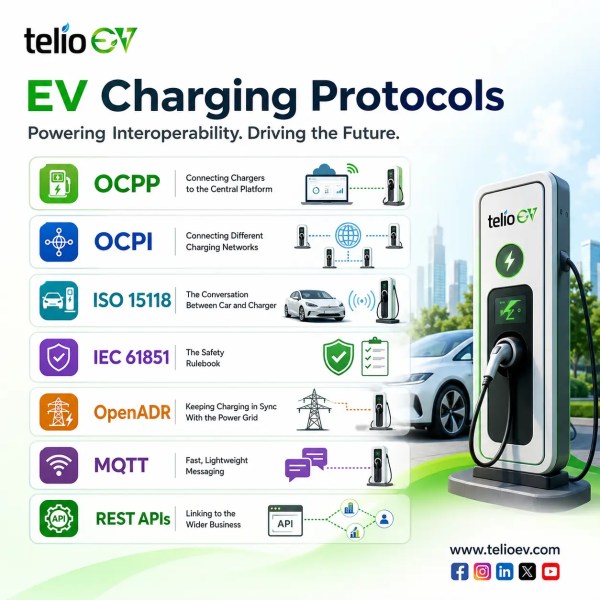
No single protocol does everything. A modern charging network relies on several of them working at once, each responsible for a specific part of the puzzle:
- OCPP connects individual chargers to the central management platform.
- OCPI connects that platform to other operators and service providers for roaming.
- ISO 15118 handles the direct conversation between the vehicle and the charger.
- OpenADR keeps charging activity responsive to the power grid’s needs.
- MQTT and REST APIs move data efficiently between devices and business systems.
- TLS and certificates protect every one of these connections.
TelioEV’s software brings all of these workflows into a single platform, so operators can monitor chargers, manage drivers, review sessions, and process billing from one place — rather than juggling separate, disconnected systems.
Benefits of Open Protocol Support
Because TelioEV relies on open, industry-standard protocols rather than a closed proprietary system, operators and drivers see several concrete advantages:
- Wider charger choice — operators can connect compatible hardware from different manufacturers instead of being locked into one brand.
- Simpler expansion — new sites, chargers, and partners can be added with far fewer custom integrations.
- Better roaming — drivers gain access to partner networks through shared interfaces, without needing a separate account for each one.
- Smarter energy use — the platform can respond to grid signals and manage demand intelligently.
- Clearer billing — reliable, complete session data supports accurate fees and settlements.
- Stronger driver experience — finding a station, starting a session, and paying all become simpler.
Quick Reference: Protocols at a Glance
Protocol | Connects | What it does |
OCPP | Charger ↔ central platform | Remote monitoring, start/stop, live status |
OCPI | Network ↔ network | Roaming across different charging companies |
ISO 15118 | Vehicle ↔ charger | Plug and Charge, power negotiation, V2G |
IEC 61851 | Vehicle ↔ charger (hardware) | Safe electrical signaling |
OpenADR | Grid ↔ charging network | Demand response, load shifting |
MQTT | Device ↔ platform | Lightweight alerts and telemetry |
REST APIs | Software ↔ software | Connecting apps, billing, fleet tools |
TLS / Certificates | All connections | Encryption and identity verification |
Building a Connected Charging Network
Protocols are the invisible foundation of a reliable EV charging network. They’re what allow chargers, vehicles, apps, operators, and the power grid to understand one another, even when they come from completely different companies. That’s why the choice of software — and how broadly it supports these open standards — matters as much as the hardware itself.
By combining OCPP, OCPI, ISO 15118, and the other standards covered here, TelioEV’s EV Charging Management Software gives operators a platform that can grow, adapt, and stay secure as the charging network expands — while giving drivers a simpler, more connected experience along the way.


